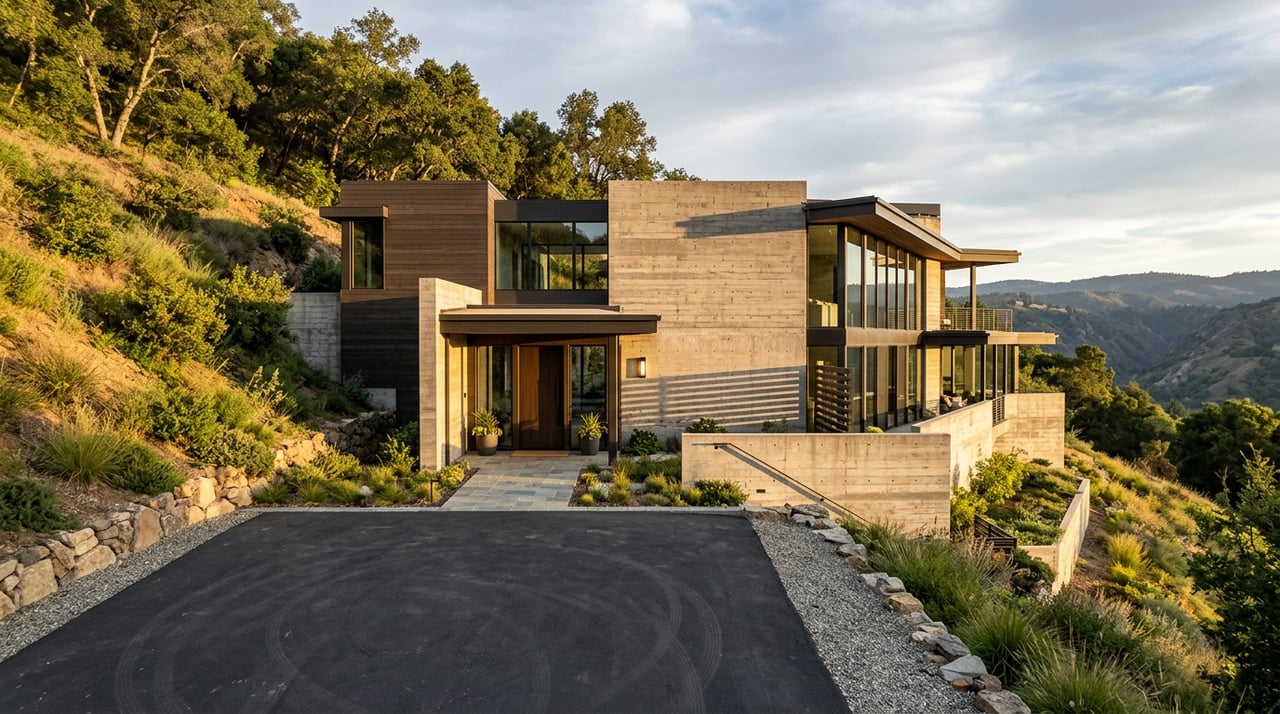
Hollywood Hills Hillside Lot Grading Limits, Explained
September 10, 2026
September 10, 2026
A buyer in contract on a view lot off Wonderland Avenue hires an architect, sketches a flat motor court, a pool, a slightly larger pad for the main house. The design looks reasonable on paper. Then the civil engineer runs the grading math and delivers the number that actually governs the project: the cut and fill required to build that plan exceeds what the City of Los Angeles allows on that lot, by right, before anyone applies for an exception.
This is not a story about construction costs running over. It is a story about a number that exists before the first excavator shows up, tied to the lot's zoning and slope rather than to what the buyer paid or how large the budget is. Two lots can list for nearly the same price and have almost nothing in common once you ask how much earth the city will let you move.
Los Angeles designates a parcel a Hillside Area when its natural slope reaches 15% or greater, based on USGS topographic data. Most of Hollywood Hills, from the canyon floors up to Mulholland Drive, falls under this designation. Once a lot is classified as hillside, the city's Baseline Hillside Ordinance sets a hard limit on grading: 500 cubic yards plus 5% of the total lot size, cut and fill combined.
The word that trips people up is cumulative. The ordinance does not let a project net out cut against fill. If a design calls for cutting 600 cubic yards on one side of the pad and filling 300 on the other, the city counts 900 cubic yards toward the cap, not the 300 a homeowner might expect from simple subtraction. On a 5,000 square foot lot, the base allowance works out to 750 cubic yards total, cut and fill together, full stop.
That number sits underneath every hillside renovation conversation whether or not the buyer or seller has ever heard of it.
The formula produces a starting number, but the city also sets a maximum cumulative grading figure by zone, and that ceiling overrides the formula whenever the formula's result would run higher.
| Zone | Maximum cumulative grading |
|---|---|
| R1 | 1,000 cubic yards |
| RS | 1,100 cubic yards |
| RE9 | 1,200 cubic yards |
| RE11 | 1,400 cubic yards |
| RE15 | 1,600 cubic yards |
| RA | 1,800 cubic yards |
| RE20 | 2,000 cubic yards |
| RE40 | 3,300 cubic yards |
An R1-zoned lot tops out at 1,000 cubic yards no matter how large the parcel is or how the formula's math shakes out. An RE40 lot, by contrast, can carry more than three times that allowance. The deciding factor in how much a hillside property can be reshaped is the zoning designation attached to the parcel, a detail that shows up on a zoning map, not on a listing sheet.
Two lots priced within $50,000 of each other can carry grading allowances that differ by a factor of three, depending on nothing more than a zoning line neither one's photos will ever show you.
Most of the canyon streets below Mulholland Drive climb steeply to meet it from Franklin Avenue or Sunset Boulevard, Outpost Drive, Woodrow Wilson Drive, and Wonderland Avenue among them. These roads were carved into the terrain decades before modern street standards existed, and many of them are narrow by any current measure.
The city has a specific classification for this: a Substandard Hillside Limited Street is any street under 36 feet wide, paved to a roadway width under 28 feet. Lots that front one of these streets face an additional constraint on top of the base grading cap. Earthwork import is limited to 375 cubic yards and export to 750 cubic yards, though the total still has to stay inside whatever the base formula and zone cap already allow.
For a buyer weighing a lot on one of these narrow canyon roads, the practical translation is straightforward. Getting dirt in or out to reshape a pad runs into its own limit before the overall cubic-yard cap even becomes the binding constraint. The street the lot sits on is doing quiet work in the background of every grading conversation.
Hollywood Hills carries one of the widest price spans of any Los Angeles neighborhood inside a single set of boundaries. Zillow's tracked average home value for the neighborhood stood at $1,945,658 as of July 31, 2026, down 0.3% over the prior year. That average sits on top of a market where homes near the Cahuenga Pass trade for under $1 million while estates in the Bird Streets list well into eight figures, sometimes above $20 million.
As of May 2026, the neighborhood's median sale price ran $2,106,667 against a median list price of $2,498,000, with roughly 385 active listings across the broader Hollywood Hills boundary as of late June 2026 and homes going to pending in a median of 39 days. Those figures describe transaction size. They say nothing about what a buyer can actually do with the lot once escrow closes.
A $2 million listing in Beachwood Canyon and a $2 million listing in Whitley Heights can carry the same price tag and almost nothing in common on the question that matters most to anyone planning a pool, an addition, or a flatter pad: how much earth the zone and the street will let them move. The published median is a snapshot of what buyers paid. It has no relationship to the building envelope they're inheriting.
A project that needs to exceed the by-right allowance does not simply pay a higher fee and proceed. It requires a Zoning Administrator Determination, which means an application to the Department of City Planning, a public hearing, and discretionary review before a permit can move forward.
That distinction matters more than it sounds. A buyer who assumes worst case, we'll just regrade, is treating a discretionary approval with public hearing exposure as though it were a form filed at a permit counter. It is not. This is part of why homes that need genuine structural work, or that come with access limitations on a narrow canyon street, tend to sit on the market longer and often accept price adjustments once buyers price in both the construction scope and the approval timeline attached to it.
Does the grading cap apply to every property in Hollywood Hills? Only to lots the city designates as Hillside Area, which requires a natural slope of 15% or greater. Flatter parcels closer to the base of the hills, nearer Franklin Avenue or the Cahuenga Pass, may fall outside the ordinance entirely.
Can a project ever get more than the formula allows? Yes, through a Zoning Administrator Determination. That process involves a public hearing and discretionary review, so it is possible but not automatic and not quick.
Does a bigger lot always mean more room to grade? Not once the zone cap takes over. An RE40-zoned lot can carry more than three times the maximum cumulative grading of an R1-zoned lot, regardless of price or acreage.
Does this only affect new construction? No. The same cumulative cut-and-fill ceiling applies to major remodels, additions, and accessory structures on a hillside lot, not only ground-up builds.
Grading math is not the part of a Hollywood Hills purchase most buyers think to ask about before they fall for the view. It should be one of the first questions on the table, right alongside price and square footage, because it decides what that view is actually allowed to become.
Stephen Apelian has spent two decades on the construction side of high-end properties before ever writing an offer, which means the grading question gets asked before the contingency period runs out, not after. If you're comparing Hollywood Hills lots and want a read on what a specific parcel's zone and slope actually allow, Let's Connect.
Stay up to date on the latest real estate trends.
Whether buying, selling, or investing in California or Texas, trust Stephen Apelian’s expertise, market knowledge, and proven results to guide your next move.