Tarrytown's Foundation Risk Isn't the Clay Story Austin Tells Everyone Else
September 3, 2026
September 3, 2026
Every generic guide to buying a home in Austin opens the same way: expansive clay soil, dramatic shrink-swell cycles, foundation movement as a near-universal tax on owning property here. It's accurate for a lot of the city. It's also the wrong warning for a lot of Tarrytown.
The neighborhood sits west of MoPac on Austin Chalk and limestone, a bedrock formation that behaves nothing like the deep Blackland Prairie clay under East Austin, Mueller, or Pflugerville. That's not a small distinction. It changes what an inspector should actually be looking for, what a repair bid should actually say, and what you should actually negotiate over during your option period. If you've relocated from a market where a soils report means liquefaction zones and hillside grading, the word "foundation" on a Tarrytown disclosure means something different again, and the difference is worth understanding before you're standing in an inspection with a report that doesn't match the warnings you came in expecting.
Chalk is a rigid, relatively stable bedrock. It doesn't swell in a wet spring and shrink into voids during a dry August the way the montmorillonite clay under East Austin does. For a Tarrytown buyer, that's genuinely good news. It's also not the whole story.
Lower-lying pockets of the neighborhood sit over Del Rio clay, a smaller, more localized deposit that behaves like the expansive clay everyone associates with Austin, just in patches rather than as a blanket condition. That means two homes half a block apart can have completely different foundation histories depending on whether they happen to sit over a solid chalk shelf or a buried clay lens. The risk in Tarrytown isn't uniform citywide movement. It's uneven support within a single lot, sometimes within a single foundation, where one corner rests on stable rock and another rests on soil that still wants to move.
That's the mechanism a generic Austin foundation checklist won't tell you to look for. A stair-step crack near one corner of a house, with the rest of the slab reading level, is a different diagnosis in Tarrytown than the same crack pattern in a neighborhood built entirely on deep clay. It's often a sign of differential support, not shrink-swell, and it changes what kind of repair actually solves the problem.
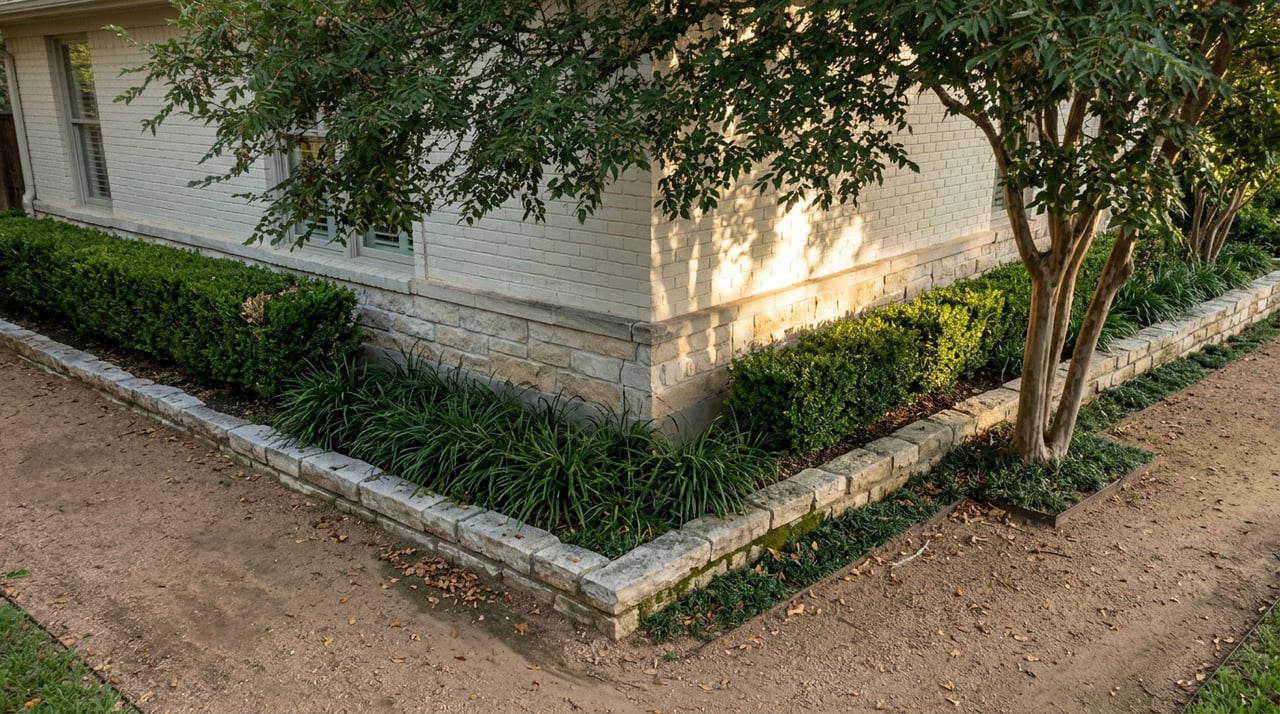
Tarrytown's mature live oak and cedar elm canopy is one of the neighborhood's defining features and also one of its more overlooked foundation variables. Large trees within 15 to 20 feet of a home draw substantial moisture from the soil beneath and around it, and they don't draw it evenly. One side of a foundation can dry out and pull away while the shaded side stays saturated, producing the same differential settlement pattern as a buried clay pocket, just driven by roots instead of geology.
This is worth sitting with for a second, because it means the tree canopy that makes Tarrytown feel established and shaded is also, mechanically, doing something to the ground your house sits on. It doesn't make the trees a liability. It makes them a variable an inspector needs to account for, the same way a chalk-clay transition needs to be accounted for, rather than assumed away because "Tarrytown doesn't have the bad soil."
Tarrytown's housing stock runs from 1930s-era estates to modern custom slab construction, and the foundation type underneath a listing changes what symptoms actually matter.
A general home inspector moving through a Tarrytown property on autopilot, applying the same checklist he'd use in Circle C or Mueller, can miss all three of these because none of them are what he's been trained to expect from "Austin foundation issues."
When something does need fixing in Tarrytown, the cost range reflects the more localized, differential nature of the problem rather than the whole-house releveling jobs common in deep-clay neighborhoods.
| Repair Type | Typical Cost |
|---|---|
| Full foundation repair project | $4,000 to $15,000 |
| Steel pier installation | $1,000 to $1,500 per pier |
| Polyurethane foam leveling | $2,000 to $5,000 |
| Typical total homeowner spend | $5,500 to $10,000 |
These figures reflect current 2026 quotes for the neighborhood. The range is wide because the underlying problem is wide. A single differential settlement issue near one corner, caused by a clay pocket or an oak root, might resolve with a handful of piers for a few thousand dollars. A home with older pier-and-beam construction and years of unaddressed crawl space moisture is a different conversation entirely.
Texas option periods typically run 7 to 10 days, which is not much time to get a full inspection scheduled, reviewed, and translated into a negotiating position. That's exactly why understanding what to look for before you're inside the house matters more here than in a market where the soil story is uniform and the checklist is generic.
A standard home inspection in Austin runs $325 to $550. For a Tarrytown property, especially anything built before the 1970s or sitting in one of the neighborhood's lower-lying pockets, that inspection is worth pairing with someone who understands the chalk-clay transition specifically, not just Austin foundations broadly. The negotiating leverage is real: documented, specific findings tied to a clear mechanism, whether that's a root system, a clay pocket, or an aging pier system, give you something concrete to bring to the seller. Sellers and their agents respond better to three or four well-supported items backed by photos and a clear explanation than to a long list of generic concerns that reads like it came from a template.
Does a stable-sounding inspection mean I can skip a foundation-specific evaluation? Not necessarily. A general inspector may not distinguish between differential settlement caused by a clay pocket and normal seasonal cracking, especially in a neighborhood where the dominant geology is stable enough that they aren't primed to look closely.
Are older Tarrytown homes automatically riskier than newer construction? Not automatically. Pier-and-beam homes fail differently than slabs, not necessarily more often. The right question is which foundation type the specific home has and what that type's known failure patterns look like.
Does having a basement change what I should ask for? Yes. Basements are unusual enough in this part of Austin that a general inspection checklist may not weight them appropriately. Ask specifically about water intrusion history and any prior waterproofing work.
Tarrytown's geology is a genuine advantage over much of Austin, but it's an advantage with edges, not a blanket exemption. Knowing where those edges are, in the low-lying clay pockets, under the oak canopy, in the gap between a 1940s pier-and-beam home and its slab-built neighbor, is what turns an inspection from a formality into a real negotiating tool.
That's the kind of detail that comes from having stood inside more than a hundred of these structures, not just read the disclosure forms. If you're buying or selling a home in Tarrytown and want a second opinion grounded in what the construction actually tells you, Stephen Apelian is glad to walk through it with you. Let's Connect.
Stay up to date on the latest real estate trends.
Whether buying, selling, or investing in California or Texas, trust Stephen Apelian’s expertise, market knowledge, and proven results to guide your next move.