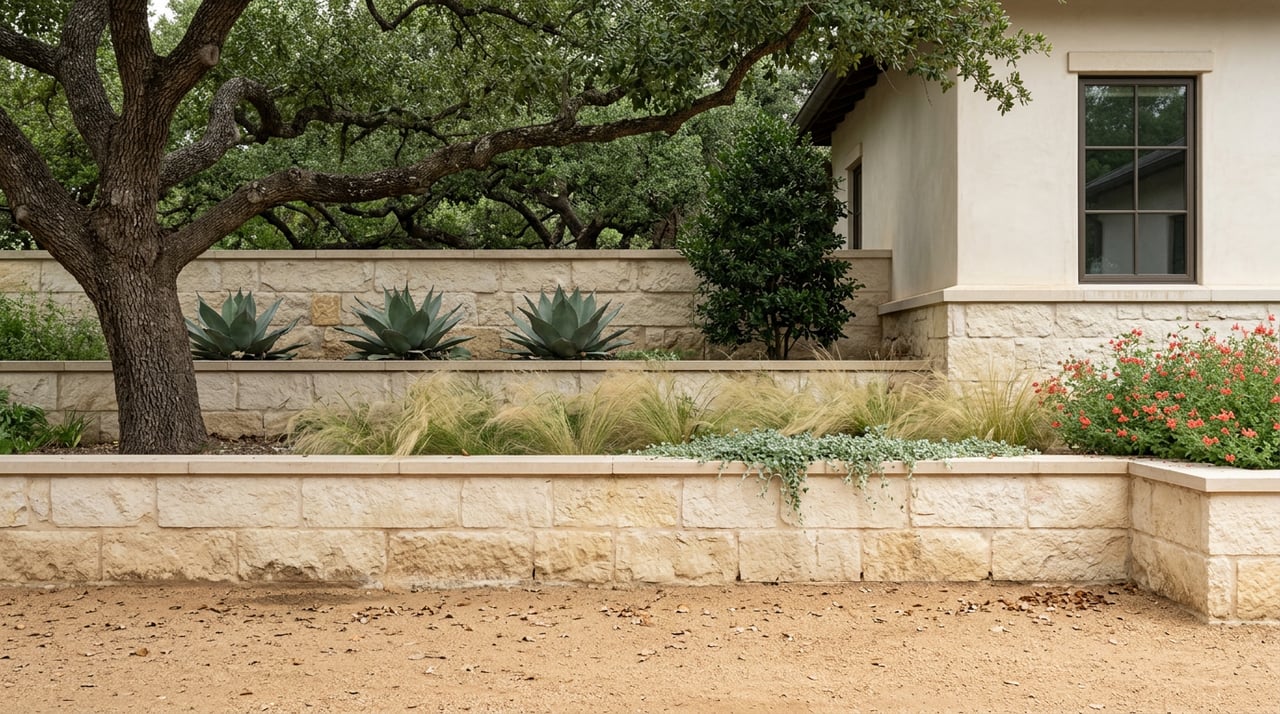
The 78735 Median Fell 18% This Year. Barton Creek Estate Prices Went Up.
August 6, 2026
August 6, 2026
If you started your Barton Creek search on a national portal this spring, you probably saw a headline number that suggested the neighborhood had cracked. The 78735 ZIP code posted the largest year-over-year median decline of any Austin ZIP in the 2026 dataset, dropping from roughly $1.52M to $1.25M. That is a real number. It is also the wrong map.
The estates that most out-of-state buyers picture when they hear "Barton Creek" — the gated sections behind the Country Club, the Amarra streets, Barton Creek West — have not repriced downward. They have appreciated modestly, sat longer on market, and traded through a wider negotiation spread. The ZIP-level median moved because the composition of what sold moved, not because a $3.5M estate on Verano Drive is now a $2.9M estate.
78735 is a mixed ZIP. It contains the gated Barton Creek Country Club community, the Lantana pocket, and a meaningful volume of condos and attached product along Southwest Parkway priced well under $1M. When higher-end transactions slow and lower-end transactions hold their pace, the median shifts even if no individual home changes value. That is what a Team Price analysis of 75 Austin ZIP codes flagged in April 2026: the 78735 median fell from $1,523,290 to $1,246,905, a drop of 18.1 percent and the largest dollar decline of any ZIP code in the metro.
Read that alongside the tier-level cut in the same dataset and the story reverses. Across the 75 ZIP codes tracked, the ultra-luxury tier of homes priced above $1.5 million was the only segment posting positive average gains, with three of four ZIP codes up and an average gain of plus 3.5 percent. The Barton Creek Country Club community itself, measured at the sub-community level rather than the ZIP level, sat at roughly 3.1% year-over-year appreciation in Q1 2026, with average values between $2.18M and $2.22M.
| Data cut | Median or average | YoY change | What it captures |
|---|---|---|---|
| 78735 ZIP aggregate | $1,246,905 median, YTD 2026 | -18.1% | All product types across the ZIP, including condos and attached homes |
| Austin >$1.5M tier | +3.5% average | +3.5% | The luxury cohort by price band, metro-wide |
| Barton Creek community | $2.18M–$2.22M average, Q1 2026 | +3.1% | Sub-community data for the gated estate sections |
The buyer who anchors on the -18.1% figure and then tours Amarra Drive is going to be surprised by the list prices. The buyer who anchors on $2.2M is closer to the truth, but still missing the sub-community structure underneath it.
Barton Creek is not a single market. It is a set of enclaves that share a name, a country club membership, and a set of environmental constraints, but that trade at genuinely different price points and paces. The bands most active in 2026:
Recent listing activity confirms the top end has not softened in list-price terms. A mid-July 2026 pull of active Barton Creek inventory showed 22 homes on market, average days on market of 109, and a median list price of $3.1M with average price per square foot near $715. Sale-to-list has settled around 94% across the community, meaning a well-priced $3M estate is trading roughly $180K under original list. That is not a distressed number. It is a negotiation spread you can plan around if you know which section you are in.
Aggregate days on market for Barton Creek runs about 92 to 115 days, but the average hides a bimodal market. In early 2026 Seely Properties' segmentation showed roughly 45 days on market in the entry-luxury tier and more than 180 days above $3M. The luxury segment priced above two million dollars has seen days on market grow to approximately 111 days with inventory remaining elevated at around 16 months of supply at the metro level, and Barton Creek sits at the deeper end of that distribution.
That matters for two reasons. First, a buyer touring $3M–$5M product in Amarra or Barton Creek West has time. There is no April 2021 urgency in this segment. Second, the negotiation discount widens with days on market, so the 94% average sale-to-list ratio is not evenly distributed. The estate tier is where the 8% to 10% concessions live. The Villas and Estates tiers move closer to list because the buyer pool is broader and Eanes ISD demand keeps competition warmer.
The other transaction friction worth naming: at the top of the market a meaningful share of activity never touches the MLS. Industry write-ups of the >$5M Austin tier describe a segment where inventory is thinner, the buyer pool is smaller, and a meaningful share of transactions happen off-market or through broker networks before a home ever appears on the MLS, so buyers at this level benefit from working with agents who have active relationships in the segment rather than relying solely on public listing searches. If your search is limited to what shows up on portal alerts, you are seeing a partial market.
The reason Barton Creek's estate tier has held up while the ZIP-level median dropped is not sentiment. It is regulation, and it applies at the parcel level.
Barton Creek sits over the Edwards Aquifer's Barton Springs recharge zone. Under the City of Austin's Save Our Springs Ordinance, most properties in the community are capped at 15% to 25% impervious cover, depending on the specific zoning and watershed classification. That single rule shapes almost everything a builder-minded buyer would want to evaluate:
The Austin Board of Realtors and the brokerages tracking the western prime corridor have noted that the pace of activity has improved through Q1 2026, with the prime western corridor of Westlake, Tarrytown, and Barton Creek leading the recovery. The SOS constraint is a large part of why. When supply cannot expand and the buyer pool for the top tier is qualified and patient, the correction shows up as longer days on market and wider negotiation spreads, not as list-price capitulation.
The practical implication during due diligence: pull the impervious cover calculation for the specific parcel before you write the offer, not after. The number on the site plan tells you what your renovation ceiling actually is. Two homes across the street from each other can have very different remaining budgets under the ordinance depending on when they were built and what has been added since.
The reason all of this matters for a relocation buyer is that Barton Creek's headline number invites an unflattering comparison with Westlake Hills and Tarrytown, both of which have looked stronger on paper this year. Barton Creek generally offers a lower price per square foot in the $553 to $668 range compared to West Lake Hills at $756 and above, while delivering a resort-style lifestyle centered on the Omni Barton Creek Resort, hill country terrain, and gated seclusion.
That price-per-foot delta is real, and part of it reflects the trade-off between walkability and acreage. Tarrytown and Westlake Hills deliver closer-in proximity and, in Westlake's case, uniform Eanes ISD zoning. Barton Creek delivers lot size, four championship courses at Barton Creek Country Club including Fazio, Palmer, and Crenshaw designs, and the SOS-protected supply floor. It also delivers a school-zoning nuance that catches out-of-state families: portions of Barton Creek fall under Austin ISD and portions under Eanes ISD, and the boundary can affect list price by a wider margin than most buyers expect. Verify the address, not the community.
Is Barton Creek a buyer's market or a seller's market in 2026? Neither, uniformly. Below $2M, well-priced homes are moving within 45 to 60 days close to list. Above $3M, the market favors patient buyers with 8% to 10% of negotiation room built in and days on market often past 180.
Why does the ZIP median look so much worse than the sub-community data? 78735 mixes gated estate sections with condos and attached product along Southwest Parkway. When the estate tier's transaction pace slowed and the lower-priced product kept trading, the median composition shifted downward without individual home values falling by anything close to 18%.
What is the single biggest due-diligence item unique to Barton Creek? The impervious cover calculation under the Save Our Springs Ordinance. It determines what you can actually build, add, or expand on the parcel, and it is not something a listing photo will tell you.
How much of the top-tier inventory is off-market? A meaningful share above $5M never reaches the public MLS. If your search is limited to portal alerts, you are seeing a subset of what is actually available.
If you're evaluating Barton Creek against Westlake, Tarrytown, or a cross-market move from Los Angeles, the right comparison starts with the parcel-level facts under each address, not the ZIP-level median. That is the work I do for every client, informed by two decades of building and remodeling high-end homes. To discuss a specific section, a specific listing, or a specific renovation scope under the SOS constraints, Stephen Apelian is available for a private consultation.
Stay up to date on the latest real estate trends.
Whether buying, selling, or investing in California or Texas, trust Stephen Apelian’s expertise, market knowledge, and proven results to guide your next move.